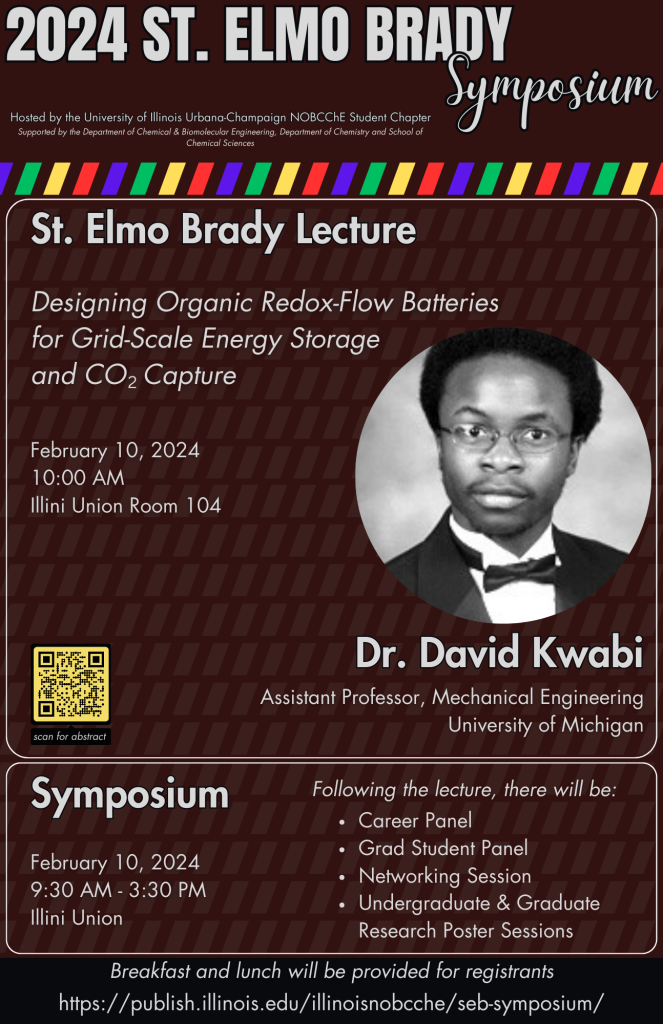

Designing Organic Redox-Flow Batteries for Grid-Scale Energy Storage and CO2 Capture
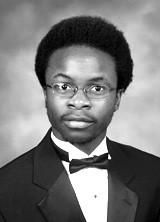
David Kwabi, PhD is currently an Assistant Professor of Mechanical Engineering at the University of Michigan
Dr. Kwabi’s lecture will be part of the 2024 St. Elmo Brady Symposium. Additional symposium information can be found under the ‘2024 St. Elmo Brady Symposium’ tab or by clicking this link.
Seminar Abstract:
Avoiding the most severe consequences of climate change will require drastic reductions in net anthropogenic CO2 emissions. These reductions can be achieved by increasing the pace at which carbon-free/renewable power is adopted to replace fossil fuel-based power, capturing and permanently sequestering CO2 away from the atmosphere, or both. Certain technological developments are required for either strategy to be widely deployed. Because renewable (e.g. solar and wind) power is intermittently available, cost-effective storage technologies are critically needed so that it can be extensively deployed on the grid. CO2 capture technology must likewise be cheap and energy-efficient while enabling high rates of CO2 uptake from point and distributed sources. Electrochemical devices are promising candidates for both tasks, as they can store electrical energy in the form of batteries and enable selective separation processes – in the latter case, without the Carnot efficiency limit that conventional thermal separation methods face. In this talk, I will discuss our group’s recent progress in using numerical modeling and statistical inference techniques to understand the performance of organic redox-flow batteries for grid-scale energy storage. I will also discuss how these techniques can be extended to understanding the fundamental and practical performance limits of a new electrochemical CO2 capture scheme driven by reversible pH swings created by proton-coupled electron transfer in aqueous electrolytes.
Biography: David Kwabi is an assistant professor in Mechanical Engineering at the University of Michigan, Ann Arbor. He earned his undergraduate and graduate degrees in Mechanical Engineering from Princeton University and the Massachusetts Institute of Technology, respectively, and was a postdoctoral fellow at Harvard University. His group designs and studies electrochemical devices for applications in energy storage and environmental remediation, with a special emphasis on resource recovery and climate change mitigation.