deep roots, healthy communities.

The Lotspeich-Yadao Lab examines how economic and social precarity shape health outcomes and quality of life among rural communities and military veteran populations. We use advanced quantitative and spatial methods from population health and social epidemiology to understand how employment quality, economic security, and material well-being function as fundamental determinants of health in rural contexts.

Our research uses administrative microdata in unconventional ways—linking local, state, and federal program data to reveal how uneven development and structural change concentrate health risks in disadvantaged communities. By examining the intersection of where people live and how they work, we identify pathways through which economic instability creates health-harming behaviors and outcomes.

We lead interdisciplinary teams that bridge communities, researchers, and federal agencies to transform complex data into actionable interventions. Through the University of Illinois Cooperative Extension Service, we honor the Land Grant Mission by serving Illinois taxpayers with rigorous applied science, transparency, and accountability. Our work trains the next generation of applied agricultural social scientists and public health practitioners to conduct spatially-informed research and develop programs with measurable impact on community outcomes.

Our framework addresses four interconnected structural challenges facing public health.

1. Precarity through regional economic restructuring. Rural labor markets have experienced dramatic restructuring, with loss of middle-class employment, rise in underemployment and job churn, and growth of informal gig work and necessity-driven entrepreneurship. We investigate how this economic instability creates health-harming pathways and behaviors that concentrate in particular communities.

2. Spatial mismatch between community needs and infrastructure. Distance and accessibility barriers, employment, and economic opportunities create geographic health disparities. We examine the uneven distribution of protective community resources—social infrastructure, food systems, support services—and investigate how community-level buffering factors that can protect against economic precarity.

3. Complex institutional transitions and program access barriers. Navigating major life transitions—like military-to-civilian employment—or accessing safety net programs requires coordinated, place-based systems that often don’t exist in rural areas. We study participation gaps and investigate how social infrastructure mediates access, particularly for populations experiencing multiple transitions simultaneously.

4. Measurement challenges that obscure mechanisms. Traditional measurement approaches fail to capture rural health complexity. Conventional employment metrics overlook underemployment and job instability. Political boundaries create ecological fallacies when they don’t reflect functional communities. Inadequate small-area estimation limits our ability to target interventions. We develop new measurement approaches.

Within the operationalization of these structural challenges, we have identified four key areas where we can connect empirical investigation with practical solutions for Illinois.

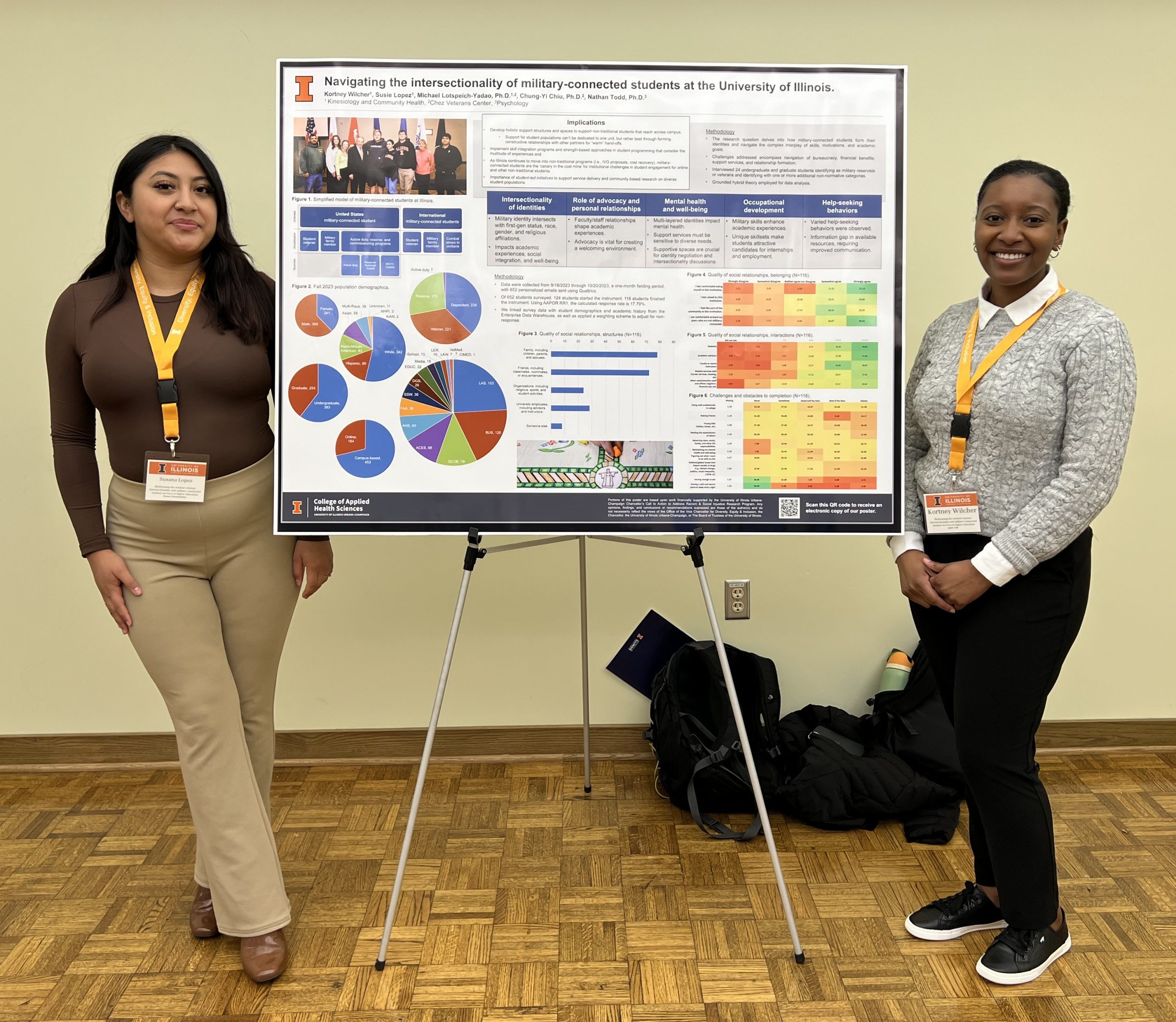
Understanding how military veterans navigate post-service pathways. When veterans return to civilian life in rural America, their success depends on more than individual effort—it depends on their community. We study how local job markets, veteran support services, social networks, and community resources shape veteran health and well-being across different transition pathways including employment, entrepreneurship, and education. Our research asks:

  • How do veterans navigate diverse post-service pathways?
  • What community supports shape successful reintegration?
  • How do rural and urban contexts differ in supporting veteran transitions?

By mapping what community factors help or hurt veteran reintegration, we develop evidence-based transition supports that address both employment pathways and health outcomes. This work identifies practical ways that Extension programs and local organizations can support veterans in communities often overlooked in national conversations about military service.

Exploring how employment quality shapes health trajectories and program participation. Traditional measures of employment miss critical health factors: working multiple part-time jobs, cycling between temporary positions, or starting a business out of necessity rather than opportunity. We investigate how employment precarity—unstable work, inadequate pay, underemployment—intersects with residential context to shape health outcomes over time. Our research asks:

  • How does employment quality shape long-term health trajectories?
  • What role does residence play in buffering or amplifying precarity effects?
  • Which community factors protect against the consequences of job instability?

Using secure federal datasets that link employment records, tax data, and health information, we track how job quality affects disability, mortality, and participation in safety net programs. This work reveals how employment precarity drives gaps in nutrition assistance enrollment, identifies community-level factors that can buffer against poor employment conditions, and provides evidence for programs that improve both economic security and health in rural areas experiencing economic transitions.

Understanding geographic variation in nutritional assistance access. Even among eligible families, participation in nutrition assistance programs varies dramatically by location. We investigate what drives these participation gaps beyond income differences, examining how enrollment timing varies and whether place-based interventions can reduce access barriers. Our research asks:

  • What drives participation gaps beyond income eligibility?
  • How does enrollment timing vary across different rural contexts?
  • Can place-based interventions reduce barriers to program access?

Our research shows that proximity to trusted community institutions—like senior centers, schools, and food pantries—increases program participation by helping families navigate complex systems and build trust. We examine these patterns across different populations, including military families and people with disabilities, to understand how economic instability, employment transitions, and rural infrastructure limitations create barriers to basic food security. This work helps Extension better target outreach where needed most, while informing community-level interventions that address employment quality, job security, and organizational support as pathways to improved program participation.

Translating research into measurable community health improvements. Our research doesn’t stop at identifying problems—we focus on creating actionable solutions. We work to translate research findings into practical strategies that practitioners and communities can implement. Our research asks:

  • How can we use research to create measurable improvements?
  • How can practitioners use data to refine implementation in real-time?
  • How do we assess implementation effectiveness in diverse rural contexts?

We develop place-based enrollment strategies and community interventions designed to reduce barriers not just to current programs, but to future health program participation. By identifying community-specific protective factors and building implementation capacity among local organizations, we help communities leverage their existing strengths while addressing gaps in infrastructure and support systems. Our work establishes new approaches to small-area estimation and evaluation that allow for more precise targeting of resources and ongoing refinement of interventions based on local data.

Our research generates new knowledge about how rural economic precarity affects health, while building community effectiveness in implementing evidence-based interventions. By working at the intersection of research, Extension, and graduate education, we create sustainable pathways for improving public health outcomes—identifying not just what works, but how to make it work in the specific contexts where rural communities live and veterans return home.

Lotspeich-Yadao Lab
908 W. Nevada Street
Urbana, Illinois 61801
(217) 332-5725