New Paper – Soft Slippery Surface Layers!

Some of the most exciting work to come from Chris Johnson’s thesis was the ability to control the dimensions and contact mechanics of polyacrylamide hydrogels by simply starting with different recipes for the hydrogel in the first place. We already knew that the composition controlled the bulk structure, but now we know it controls the […]

So, why are hydrogels so slippery?

I have started many posts this way, but in fact we keep discovering more reasons. I’m thrilled to share that our recent work shows how hydrogel surfaces have an innate structure that allows them to maintain robust low friction: a gradient layer. When you submerge a hydrogel into a water bath, the polymer chains want […]

Congratulations to Chris on his successful PhD defense “Tribological properties of gradient-density hydrogel surfaces”

Hydrated gels are very slippery, and we now know it’s partly due to their surfaces! Chris made composite hydrogels with a soft surface skin, then fully characterized the effective stiffness of that layer, contact mechanics, and how it contributes to good lubrication (or not!) He did an impressively-large number of experiments involving materials synthesis, careful […]

Congratulations Jiho – new professor at Hongik University, Seoul

Please join me in congratulating Jiho on his new position as a full-time faculty of Mechanical and System Design Engineering at Hongik University. I met Jiho the first week after arriving at Illinois, so my work over the past 7 years and success have always included him, and depended upon him! He graduated in 2020 […]

New paper out: “Cartilage-like tribological performance of charged double network hydrogels”

While we normally work with single-polymer hydrogels, we had the opportunity to work with the Grunlan group at Texas A&M to study their charged double-network hydrogels. These hydrogels are tough! Looking more like cartilage all the time. In this paper we present evidence that their lubrication behavior matches or exceeds that of native cartilage. Higher […]

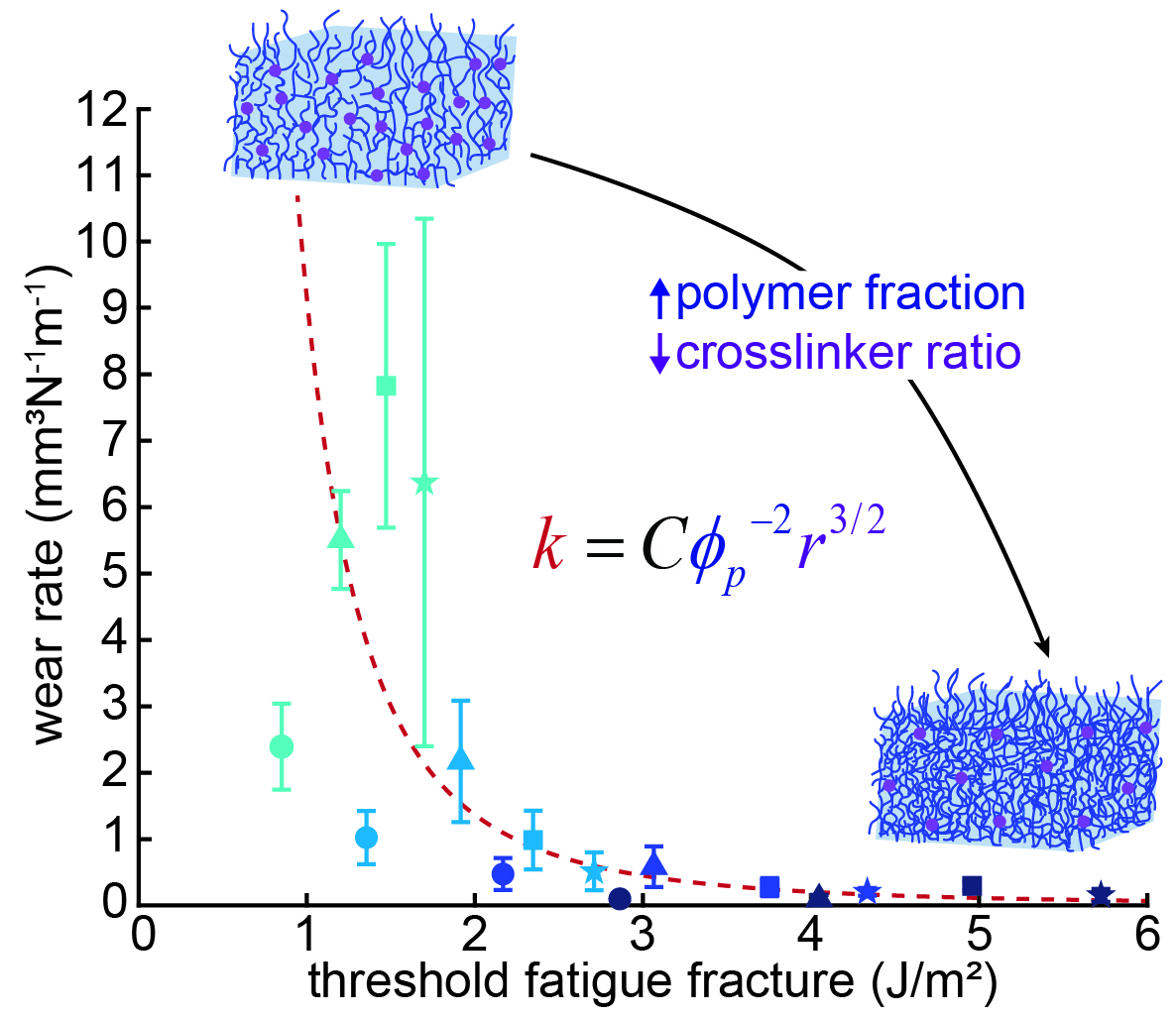
New paper out: “Compositional Dependence of Polyacrylamide Hydrogel Abrasive Wear Resistance”

Many researchers are aware that hydrogels, even a single kind of hydrogel (polyacrylamide) can be designed to have properties that range from brittle to viscoelastic. It’s truly a versatile material! As hydrogels are being considered as replacements for cartilage in the body, they need to be able to take a beating: they can’t break under […]

Congratulations to Shab on her successful PhD defense on Friday! “Wear mechanisms of chemically crosslinked hydrogels under mild abrasion”

Hydrogels are the next “engineering material” that we need new textbooks for, to teach the next generation of engineers to design with them. Shabnam’s work contributes directly to that, and over the past 4 years she has discovered that the material nature of the hydrogel determines how it wears away — sometimes it acts brittle, […]

Materials Tribology Laboratory
Email: acd@illinois.edu