

Mode Control Anti-Phase Coating
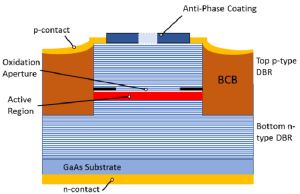
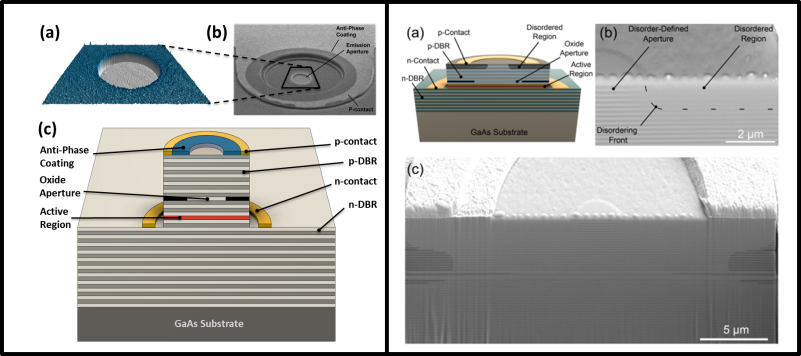
By utilizing an anti-phase coating (APC) and impurity-induced disordering (IID) for filtering higher-order transverse modes, VCSEL performance is enhanced by reducing beam spot size and increasing signal-to-noise ratio (SNR) in optical transcievers. These methods have produced world-record results, along with numerous publications and conference proceedings. Current/future work involves polarization control by changing the filter size/shape and application into 2D-VCSEL arrays for sensing applications.
Related News + Publications
- Kevin Presents Mode-Control Research at CS MANTECHAt the 2023 CS MANTECH conference, Kevin presents his work on using anti-phase coatings to achieve high-power, single-mode performance in VCSELs.
- Robert, Kevin, and Leah Present at the Engineering Research Fair
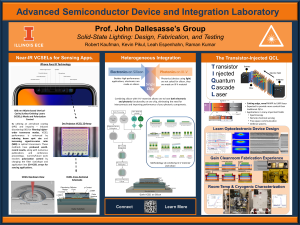 Robert Kaufman, Kevin Pikul, and Leah Espenhahn present a high-level view on the research conducted within the group at the 2023 Engineering Research Fair. Over the course of two hours, 74 undergraduate students show interest in the group and the research being performed.
 - Achieving high-power single-mode operation in vertical-cavity surface-emitting lasers via scalable, higher-order mode suppression techniquesAchieving high-power single-mode operation in Vertical-Cavity Surface-Emitting Lasers (VCSELs) has received renewed interest due to performance needs driven by facial recognition and 3D imaging in mobile telephones. Two distinct mode control methods that rely on exploiting the spatial field distribution of optical transverse modes to achieve high-power single-mode operation in VCSELs will be discussed. The… Read more: Achieving high-power single-mode operation in vertical-cavity surface-emitting lasers via scalable, higher-order mode suppression techniques
- Impact of Diffusion Profile on the Modulation Response of Single-Mode Disorder-Defined VCSELsThe impact of diffusion profile shaping through the use of tensilely and compressively strained diffusion masks on the modulation response of single-mode vertical-cavity surface-emitting lasers (VCSELs) using disorder-defined apertures is investigated. VCSELs designed for high-power single-fundamental-mode emission through the use apertures defined via impurity-induced disordering (IID) in conjunction with a standard oxide-confinement process are characterized… Read more: Impact of Diffusion Profile on the Modulation Response of Single-Mode Disorder-Defined VCSELs
- Impact of Diffusion Mask Strain on Impurity-Induced Disordered VCSELs Designed for Single-Fundamental-Mode OperationThe strain of diffusion masks utilized for impurity-induced disordering is demonstrated to control the curvature of the diffusion front, and therefore disordering front, of the disordered distributed Bragg reflector (DBR) aperture. As a result, the disordered apertures formed under strain conditions varying from compressive to tensile are shown to significantly impact the electro-optical performance and… Read more: Impact of Diffusion Mask Strain on Impurity-Induced Disordered VCSELs Designed for Single-Fundamental-Mode Operation