Shifting Dwellings: Rethinking Home Through the Material Practices of Bangladeshi Immigrant Women in New York
Mania Taher (Art & Design) was a 2026 HRI Summer Faculty Fellow. She spent her summer in New York conducting ethnographic fieldwork in support of a chapter in her current book manuscript, which will examine the resettlement experiences of Bangladeshi immigrant women in New York from the 1970s to the present.
Describe your research. What question or questions are you seeking to answer?
My ongoing book manuscript uncovers how first-generation Bangladeshi immigrant women in New York City reshape their dwellings and neighborhoods into spaces of adaptation, resilience, and identity through everyday use of urban spaces, domestic activities, and object practices. This research reveals how dwellings, objects, routines, and neighborhood spaces function as critical infrastructures of migration, arguing that for Bangladeshi immigrant women, spatial categories such as “domestic” and “public” are not fixed or oppositional but relational and overlapping. As part of these experiences, they often navigate blurred territories and negotiate shifting timeframes by inhabiting them through their daily routines. Their daily routines produce a spatial continuum in which care work, social reproduction, and political engagement coexist across scales.
This summer, I spent one and a half months in New York conducting ethnographic fieldwork in Bangladeshi-dominated neighborhoods and dwellings in Kensington (Brooklyn), Hillside and Ozone Park (Queens), and Parkchester (Bronx). Through semi-structured interviews, I asked participants about their daily routines in current and previous dwellings in New York and Bangladesh, focusing on their sensory and emotional experiences within these spaces. I also documented material conditions through photographs and drawings during visits to their dwellings. This architectural and material analysis, combined with detailed resettlement activities, deepens anthropological understanding of their resettlement experiences in New York. I also met Bangladeshi women organizers, interviewed them about their organizational histories, and attended their organized events. Drawing on Bangladeshi women’s experiences of both everyday living and collective organizing, I argue that their distinct ways of conveying temporality within spatial settings reflect a non-Western logic of place construction in built landscapes that were not designed for them.
What drives your interest in the topic?
As a Bangladeshi woman myself who first landed in New York as an international graduate student in the United States, I have a deep personal connection to this project. Being a Bangladeshi immigrant woman, I had better access to the research participants in their households during the pandemic, when I began this research as my PhD dissertation at the University of Wisconsin-Milwaukee. I have always communicated with these research participants regarding my researcher status as a non-New Yorker, middle-class, female Bangladeshi academic. My research participants have given me tremendous support by granting me access to their spaces and time, as well as for follow-up interviews and visits. What drives me further in researching this topic is realizing that by centering Bangladeshi immigrant women’s lived experiences in New York, this research challenges dominant immigrant narratives around male migration histories and formal institutions as primary sites of diasporic formation.
How did the Summer Faculty Fellowship support your work?
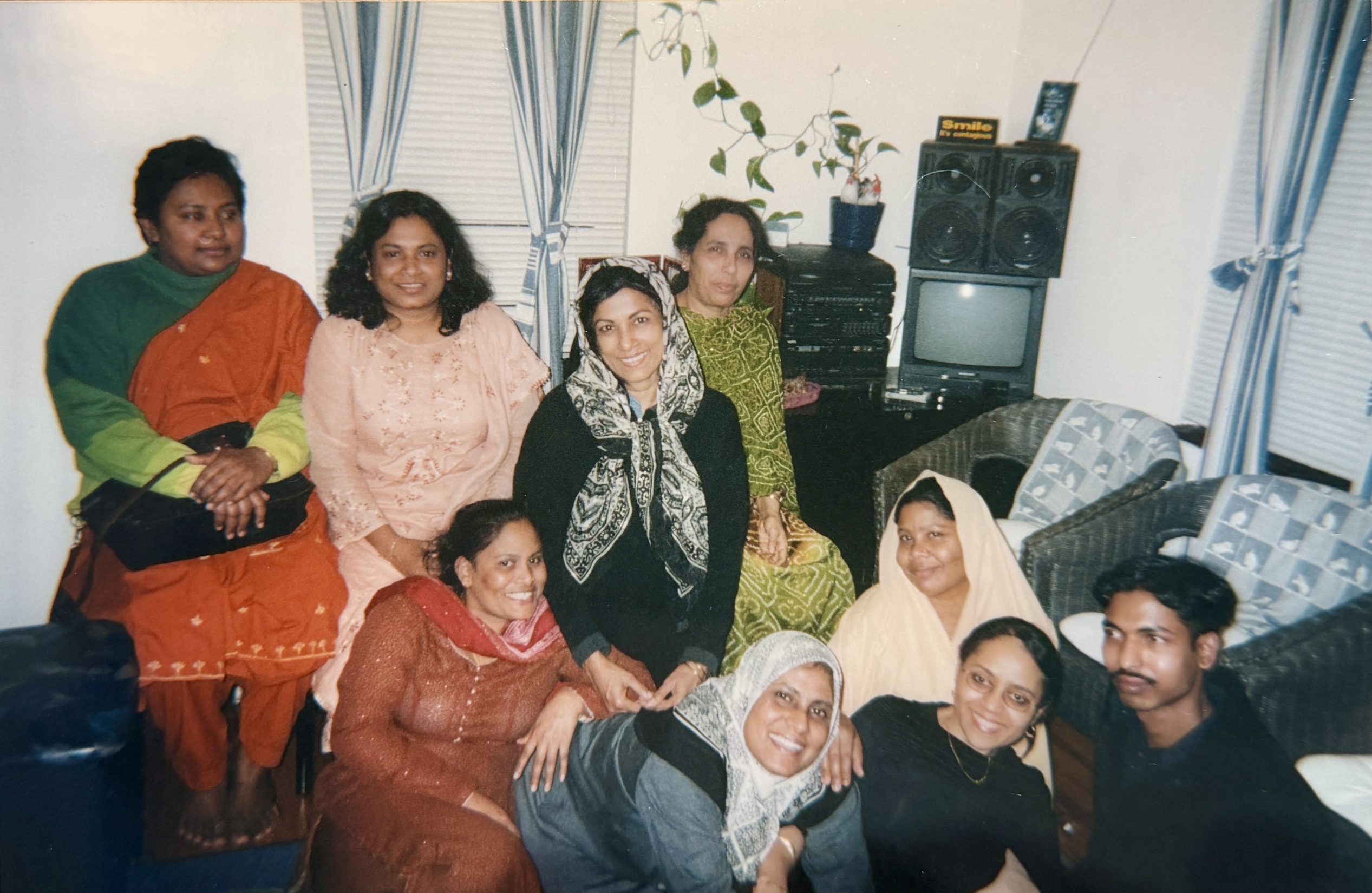
The fellowship provided me assistance to continue fieldwork in New York this summer as I was planning earlier. During this visit, I focused on gathering evidence for a chapter I’m tentatively titling “Gathering,” which examines how Bangladeshi women’s organizing efforts have shaped public space in their New York neighborhoods, often originating as gatherings inside their dwelling spaces.
Among many activities over the summer, I attended Nakshi Kantha (a traditional sewing practice from Bengal) workshops organized by the Bangladeshi Ladies Club (BLC), held across four public sessions in June 2026 at Avenue C Plaza in Kensington, Brooklyn, which drew women from both near and far. I also reviewed grassroots non-profit organization Andolan’s archived documents at New York University’s Special Collections to learn more about the organization’s history in the 1990s and early 2000s. More broadly, I recently submitted a journal article, partly based on this fieldwork, examining Nakshi Kantha’s capacity to gather feminist counterpublics, where I show how Kantha stitching across transnational contexts becomes a means of gathering, claiming public space, and sustaining community.
Figure: A gathering of Andolan organization members at Nahar’s Alam’s dwelling, undated. Source: Andolan (Organizing South Asian Workers) Records; WAG.354; Box 2; Folder 9, Robert F. Wagner Labor Archives; New York University (NYU).