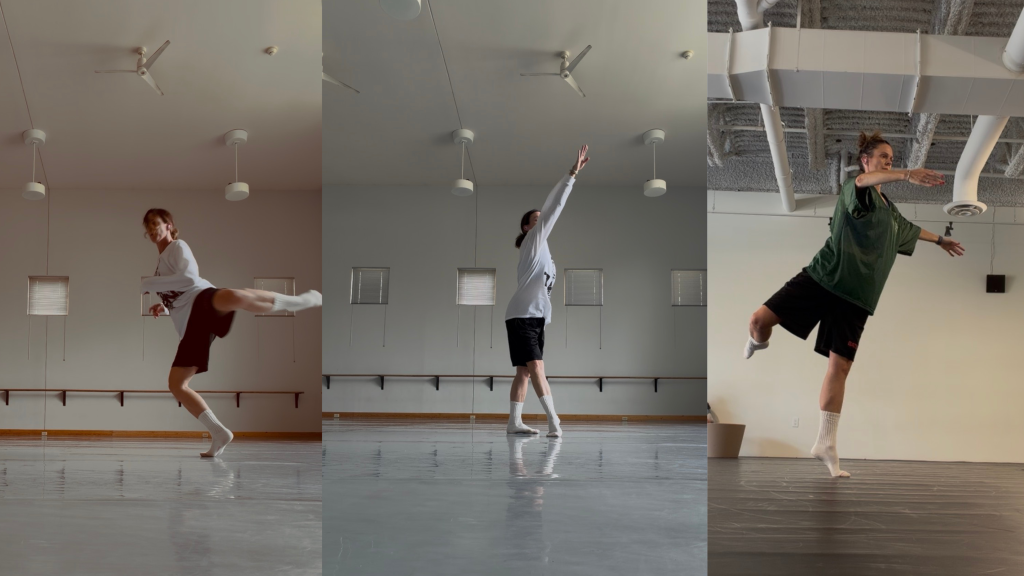
Paige Cunningham Caldarella (Dance) was a 2026 HRI Summer Faculty Fellow. She engaged in choreographic research exploring Merce Cunningham’s seminal 1958 piece, Summerspace, as both a historical anchor and a contemporary provocation.
Describe your research. What question or questions are you seeking to answer?
As a choreographer, educator, and performer, my research is situated at the intersection of ballet, contemporary ballet, and modern dance as both artistic practice and a site of deep movement investigation—not to uphold these forms uncritically, but to understand better, challenge, and innovate from within them. I am especially drawn to these words from choreographer and former Merce Cunningham dancer Karole Armitage: “Contemporary ballet works from inside the system, changing the look and expression of ballet to reflect our times.”
Merce Cunningham’s Summerspace as a Departure Point for Contemporary Reflection is firmly rooted in practice-based choreographic research, investigating contemporary ballet and the movement vocabulary of Merce Cunningham as both artistic forms AND sites of embodied knowledge production. Rather than treating the Cunningham legacy as static inheritance, I am curious about ways that historical dance forms and artistic legacies can be revitalized to address contemporary social, political, and aesthetic concerns. Merce himself questioned and explored many ideas, including the concept of “legacy.”
What drives your interest in the topic?
I performed Cunningham’s 1958 work Summerspace during my time with the Merce Cunningham Dance Company and received coaching in it from longtime leading Cunningham dancer and a founding member of the Cunningham Company, Carolyn Brown. Sitting at the intersection of ballet and modern dance, Summerspace offers a container for considering how multiple movement languages can coexist within a single choreographic structure. I am interested in the evolution of contemporary ballet, its many lineages and influences, and how my time with the Merce Cunningham Dance Company often felt like a kind of radical contemporary ballet of its own with its use of “ballet on the bottom and modern on the top.”
How did the Summer Faculty Fellowship support your work?
The Summer Faculty Fellowship allowed me to compensate artists for early studio investigations and gave me the confidence to continue developing this research in the studio. Additionally, the Summer Faculty Fellowship will continue to support my research through an upcoming trip to New York, where I will present on my work at the Center for Ballet and the Arts at New York University.