Summary
National Debates Over Money, Land, and Sovereignty in the Era of Jackson, covers conflicts between state, federal, and indigenous interests over land, the economy, and sovereignty in the United States from the late 1810s to the mid 1830s. The episode explores how the Bank War manifested into a national sense of mistrust over currency, ultimately culminating into the destruction of the Second Bank of the United States. Subsequent sections discuss the Nullification Crisis, in which politicians in South Carolina fought back against tariffs passed by Congress that they deemed to be unconstitutional, fueling tensions between the state and federal governments. And the episode closes with a discussion around court case tensions regarding indigenous land rights and management snowballed into one of the most devastating acts of forced removal.
Listening Options
Video:
Audio:
Transcript
Timeline
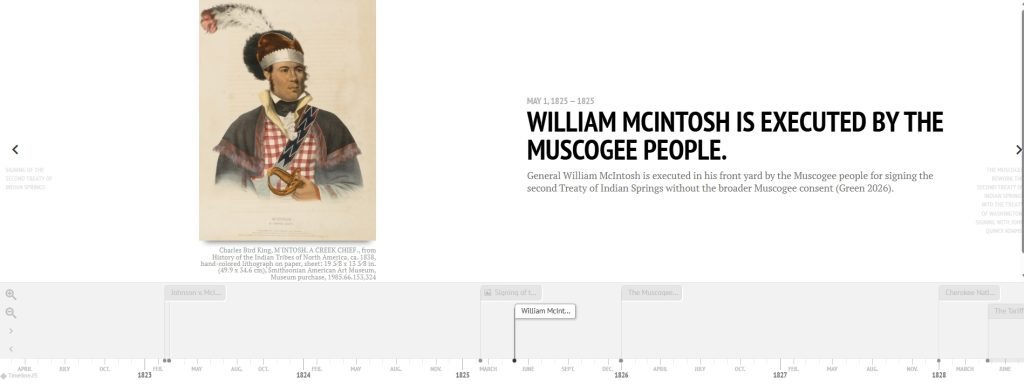
Visit the Episode Timeline on Knightlab.JS Timeline Creator – Click the Button Below
Timeline created using Knightlab’s timeline creator.
Sourcing
Annotated Bibliography – Primary and Secondary Sources
Annotated Bibliography
Primary Sources
Georgia. General Assembly. “Acts of the General Assembly of the state of Georgia, passed in Milledgeville at an annual session in November and December, 1829 [volume 1].” 1829/1831. April 27, 2026. https://hdl.handle.net/2027/uc1.a0001993955 pp. 98-102. This source is a published collection of the recently passed laws of Georgia. Published in 1830. The proximity of the laws targeting Native American autonomy to Andrew Jackson’s election suggests the Georgia legislature was confident in a lack of federal resistance to State assertion of authority under a Jackson administration.
Jackson, Andrew. Andrew Jackson to Allen Ditchfield Campbell, May 13, 1832. In The Papers of Andrew Jackson Volume 10, edited by Daniel Feller. 270. https://trace.tennessee.edu/server/api/core/bitstreams/00292701-e41d-4ba5-a3f5-e2e702c56084/content. This was another letter from Jackson to Allen Ditchfield Campbell. Similar to the Coffee letter, it started out with friendly platitudes but took a turn when Jackson discussed the National Bank. This letter was dated less than two months before the veto message and contained even more inflammatory language towards the bank. It showed Jackson’s even bigger shift and determination in trying to end the National Bank.
Jackson, Andrew. Andrew Jackson to John Coffee, February 19, 1832. In The Papers of Andrew Jackson Volume 10, edited by Daniel Feller. 98. https://trace.tennessee.edu/server/api/core/bitstreams/00292701-e41d-4ba5-a3f5-e2e702c56084/content. This primary source was a letter from Andrew Jackson to his friend John Coffee. Jackson wrote to Coffee about general things going on in his life and questions he had about Coffee. Towards the end of the letter, Jackson wrote a scathing statement about the Bank of the United States. Significantly, it showed that in private Jackson disliked the Bank and did not want to recharter it.
Jackson, Andrew. “First Annual Message to Congress.” Speech at Capitol Building, Washington D.C., December 8, 1829. Andrew Jackson’s first state of the union address to Congress contained hostile language towards the current Bank of the United States. This served as an early and important example of Jackson’s predisposition towards ending the Bank of the United States.
Jackson, Andrew. “President Andrew Jackson’s Message to Congress ‘On Indian Removal.'” December 6, 1830. Presidential Messages, 1789–1875; Records of the U.S. Senate, Record Group 46. National Archives Building, Washington, DC. https://www.archives.gov/milestone-documents/jacksons-message-to-congress-on-indian-removal. In this message, Andrew Jackson announces his elation over the passing of the Indian Removal Act, claiming that expulsion of natives will lead to prosperity for white settlement. Drawing heavily on religious themes, he also states that peaceful land cessions will benefit Native Americans, promising a thriving new lifestyle to the west.
Jackson, Andrew. “President Jackson’s Proclamation Regarding Nullification, December 10, 1832.” American Battlefield Trust, December 10, 1832. https://www.battlefields.org/learn/primary-sources/president-jacksons-proclamation-regarding-nullification-december-10-1832. This source is a transcript of President Andrew Jackson’s proclamation following South Carolina’s nullification of the federal tariff laws. In it, President Jackson argued that South Carolinians had a responsibility to respect the laws of the federal government over any loyalty they had towards their state government.
Jackson, Andrew. “President Jackson’s Veto Message Regarding the Bank of the United States.” Speech at Capitol Building, Washington D.C., July 10, 1832. Andrew Jackson’s bank veto was considered the first veto by a president to be justified through party aligned politics and not constitutional means. Because of this transformation, it shifted more political power to the president who was able to exercise more influence on congressional bills. The veto message served as one of the main primary sources in analyzing how the bank war shifted the political power in the United States and showed the new tensions in the federal government system.
Johnson v. M’Intosh. 21 U.S. (8 Wheat.) 543. Supreme Court of the United States, 1823. https://tile.loc.gov/storage-services/service/ll/usrep/usrep021/usrep021543/usrep021543.pdf This is the court report of the Johnson V. McIntosh case, a clash over land rights that was filed in 1823. This document lays out the background information of the case and presents the ruling in favor of McIntosh, citing that settlers were not allowed to engage in direct land exchange with indigenous peoples. Johnson had inherited the land through a sale with the Piankeshaw nation, whereas McIntosh bought 11,000 acres directly from congress.
McCulloch v. Maryland, 17 U.S. 316 (1819). A landmark Supreme Court case involving the authority of Congress in creating the Bank of the United States, whether a State has the authority to tax said Bank, and Supreme Court Justice Marshall’s expounding of Constitutional concepts. Showed the early tensions of the Federal government and state governments involved in rechartering the first Bank of the United States.
National Archives and Records Administration, “Correspondence and miscellaneous records, 1821–23,” image 395 of 796, Records of the Cherokee Indian Agency in Tennessee, Microfilm Publication M208, Roll 9, Record Group 64: Records of the National Archives and Records Administration, National Archives Identifier 445663926, National Archives Catalog, https://catalog.archives.gov/id/445663926?objectPage=395. This source is a declaration from Cherokee citizens that they are unanimously opposed selling or surrendering any more land. The Cherokee leaders who signed it emphasize that their remaining territory is necessary for the survival of their nation and future generations. This source is useful because it shows Cherokee political unity, resistance to removal pressure, and the Nation’s attempt to defend sovereignty through formal diplomatic language.
“Treaty with the Creeks, 1825.” In Indian Affairs: Laws and Treaties, compiled and edited by Charles J. Kappler. Vol. 2, 214–17. Washington: Government Printing Office, 1904. Oklahoma State University Library Digital Collections. https://cdm17279.contentdm.oclc.org/digital/collection/kapplers/id/29470/rec/1. This source outlines the second Treaty of Indian Springs, proposed by George Troupe and signed by Muscogee chief William McIntosh in 1825. This treaty stated that the Muscogee Nation would receive equal acreage of land in Oklahoma if they ceded what they currently held in Georgia to the state government. However, it was signed without consent of the tribe, and was later nullified by John Quincy Adams, yet Troupe still carried out efforts of forced removal.
U.S. Congress. House. An Act further to provide for the collection of duties on imports. 22nd Cong., 2nd session. Introduced in House March 2, 1833. https://loveman.sdsu.edu/docs/1833ForceBill.pdf. This source is an act known as the Force Bill. It allowed the president to use military force to compel the states to pay federal tariffs. While military force was never used, it served as a major threat to the states.
U.S. Congress. House. An Act in alteration of the several acts imposing duties on imports. 20th Cong., 1st session. Introduced in House May 19, 1828. https://fraser.stlouisfed.org/title/tariff-1828-5888?page=5. This source is an act that caused the tax rates on ubiquitous goods to increase in an attempt to decrease foreign economic power and increase domestic economic power. It is known as the “Tariff of Abominations.”
U.S. Congress. House. An Act to alter and amend the several acts imposing duties on imports. 22nd Cong., 1st session. Introduced in House July 14, 1832. https://fraser.stlouisfed.org/title/tariff-1832-5889. This source is an act in response to the Tariff of 1828 and decreased the tax rates of ubiquitous goods. South Carolina declared this act void, causing the Nullification Crisis.
(U.S. Reports: Worcester v. the State of Georgia, 31 U.S. [6 Pet.] 515 [1832], https://tile.loc.gov/storage-services/service/ll/usrep/usrep031/usrep031515/usrep031515.pdf pp. 525-528; 521. This source is a Supreme Court decision from 1832 concerning Georgia’s attempt to enforce state law within Cherokee territory. It holds that Georgia’s laws were unconstitutional because Cherokee territory was separate from state jurisdiction and protected by federal treaties. This source is valuable for its complexity because it shows how the one branch recognized Cherokee sovereignty and treaty rights, while Georgia and the Executive didn’t. It is especially useful for understanding the legal arguments surrounding Cherokee sovereignty, and it is materially useful to record the facts leading up to the case.
Secondary Sources
Andrew Jackson’s Hermitage. “Andrew Jackson & the Nullification Crisis.” Andrew Jackson’s Hermitage: Home of the People’s President. https://thehermitage.com/andrew-jackson-the-nullification-crisis. This source is from Andrew Jackson’s Hermitage, and explains the background and situation of the Nullification Crisis. It gives a timeline of events and specifically explains the resignation of President Jackson’s Vice President, John C. Calhoun. This source was useful because it provided a clear timeline of the Nullification Crisis during Andrew Jackson’s presidency.
Bowes, John P. “American Indian Removal beyond the Removal Act.” Native American and Indigenous Studies 1, no. 1 (2014): 65-87. https://dx.doi.org/10.1353/nai.2014.a843652. This article explains how the implications of the Indian Removal Act were at the center of land debates during the mid 1800s as Jacksonian Democrats sought to achieve a prosperous land for white settlers. The act enabled discourse surrounding indigenous land rights, which minimized the authority that Native Americans had over their territories.
Campbell, Stephen. “Monster News! Veto and Reelection.” in The Bank War and the Partisan Press, 67. University Press of Kansas, 2019. In Campbell’s chapter, he discussed and analyzed the role of the press involvement with the start of the Bank War up until the 1832 election. Not only did the press serve as an example of growing partisanship but the ways political power relied upon the press to spread its partisan message. Jackson’s veto was used to encourage and discourage his reelection campaign in the election of 1832. Ultimately, Jackson’s viewpoint about the Bank won out with his successful reelection and overwhelming support in the popular vote.
Cave, Alfred A. “Abuse of Power: Andrew Jackson and the Indian Removal Act of 1830.” The Historian 65, no. 6 (2003): 1330–53. http://www.jstor.org/stable/24452618. This secondary source, published in The Historian, walks through a common misconception about the Indian Removal Act of 1830. The author explains how many scholars think that the act gave the go ahead for unprecedented military removal, when in reality, Jackson was abusing his power. He disregarded key components of the act, and came up empty handed on promises he had made to win congressional approval.
Chappell, Gordon. “The Life and Activities of General John Coffee.” Tennessee Historical Quarterly 1, no. 2 (1941): 125. https://www.jstor.org/stable/42620739. A personal letter from Jackson to John Coffee was used and so this source served as background information on John Coffee. John Coffee was a brigadier general who was a friend of Jackson’s and served under him in the War of 1812. This was one of the only academic sources that gave a comprehensive overview of John Coffee’s life and relationship to Jackson.
Ericson, David F. “The Nullification Crisis, American Republicanism, and the Force Bill Debate.” The Journal of Southern History 61, no. 2 (1995). https://doi-org.proxy2.library.illinois.edu/10.2307/2211577. This article by David Ericson, a historian and professor at George Mason University, explains the sequence of events of the Nullification Crisis. He argues that the Nullification Crisis should not be viewed as a conflict between the North and the South but instead as an ideological conflict of the meaning of republicanism and the power that the federal government holds. This source was useful because it provided insight on how the Nullification Crisis represented a larger ideological conflict behind federal and state power.
Green, Ellen M. “Captain William McIntosh.” Georgia Historical Society, March 13, 2026. https://www.georgiahistory.com/ghmi_marker_updated/captain-william-mcintosh/. This source provides biographical information on Captain William McIntosh and how he came to the states, laying the foundations for his son, General William McIntosh, who would later go on to become a Muscogee Nation chief.
Grinspan, Jon. “Trying to Assassinate President Jackson.” American Heritage, January 30, 2007. https://www.americanheritage.com/content/trying-assassinate-president-jackson. A modern retelling of the first assassination attempt on a U.S. president, published on the anniversary of the event. This source provided the necessary background information to create the hook of the podcast which first started as a dramatic retelling of the event about Andrew Jackson.
Harold J. Plous, “Jackson, the Bank War, and Liberalism,” The Southwestern Social Science Quarterly 38, no. 2 (1957): 107. https://www.jstor.org/stable/42866088. Plous wrote a short but comprehensive history of the entire Bank War. He argued, while the United States Bank was far from a perfect central bank solution, it was the only one that created a sense of stability. And so, in removal, Jackson created the conditions for the coming economic panics that occurred in the late 1830s.
Haveman, Christopher D., and Kathryn E. Holland Braund. “The Removal of the Creek Indians From the Southeast, 1825-1838.” The Removal of the Creek Indians from the Southeast, 1825-1838. Thesis, Auburn University, 2009. This journal explains how the government justified the removal of the Muscogee nation via the quiet treaty, and how the majority of people who made up the native confederation opposed the signing of the second Treaty of Indian Springs. Detailed here is how the Muscogee took matters into their own hands, by executing McIntosh and petitioning for the nullification of the treaty.
“Johnson & Graham’s Lessee v. McIntosh.” Oyez. 2005. https://www.oyez.org/cases/1789-1850/21us543. This scholarly court case database explains a brief synopsis and lays out the basic facts of the Johnson V. McIntosh case that was argued in 1823. Also featured here is a question to prompt further thinking on the matter relative to the time period, “Can a Native American tribe convey land to individuals?”
Martin, Jim. “Today in History: Resignation of Vice President John C. Calhoun: In Custodia Legis.” The Library of Congress, December 28, 2017. https://blogs.loc.gov/law/2017/12/today-in-history-resignation-of-vice-president-john-c-calhoun/. This article covers the resignation of Vice President John C. Calhoun. It discusses how following his resignation, Calhoun ran for senate in his home state of South Carolina so he could protest the federal government’s tariffs in Congress. This source was useful because it provided a sequence of events and reasoning for Calhoun’s resignation.
Meerman Jacob P. “The Climax of the Bank War: Biddle’s Contraction, 1833-34.” Journal of Political Economy 71, no. 4 (1963): 379-380. https://www.jstor.org/stable/1828825. Meerman’s article discussed the under-told event of Biddle’s artificially created recession to try and force Andrew Jackson to keep the National Bank. Biddle resorted to this policy because he viewed it as a last ditch option to try and save the Bank. Meerman went over the economic data of this small recession and determined without access to more data it would be unknowable to what extent Biddle’s contraction had on the overall economy. But this last resort by Biddle would politically fail and cause the downfall of the National Bank after Biddle relented on his efforts.
Mooney, Chase. “The Second Bank and the Currency.” in William H. Crawford: 1772-1834, 127-146. University Press of Kentucky, 1974. https://www.jstor.org/stable/j.ctt130hxwm.10. This secondary source book chapter covered the history of rechartering the first Bank of the United States starting after the War of 1812 (when its charter ended in 1811). This served as an important source in providing contextual information about the rechartering processes and controversies surrounding the first recharter and provided an early example of tensions in the National Bank.
“Muscogee (Creek) Removal Dissention and Division.” National Park Service U.S. Department of Interior, 2019. https://www.nps.gov/ocmu/learn/historyculture/upload/Accessible-Muscogee-Creek-Removal.pdf. This bulletin, sourced from the National Park Service, explains the complex and pained process that culminated into the signing of the second Treaty of Indian Springs, leading to the removal of the Muscogee nation from Georgia. Also covered in this source are Adam’s shortcomings in regards to enforcing federal over state rule, ultimately bending to the state of Georgia.
Norgren, Jill. The Cherokee cases: Two Landmark Decisions in the Fight for Sovereignty (University of Oklahoma Press, 2003). This source is a book by Jill Norgren, a legal historian and professor emerita, that examines the Cherokee Nation’s fight for sovereignty through the Supreme Court cases Cherokee Nation v. Georgia and Worcester v. Georgia. It shows how Cherokee leaders, especially John Ross, used American legal arguments to challenge Georgia’s actions and defend their nation’s rights. This source is useful for context for Cherokee resistance because it explains the political, legal, and historical background behind each case. It also touches mentions other Native groups’ responses and federal responses. It is particularly useful for tracking the web of individual people who took each step along the way (and what evidence we have of those interactions).
Perkins, Edwin. “Lost Opportunities for Compromise in the Bank War: A Reassessment of Jackson’s Veto Message.” The Business History Review 61, no. 4 (1987): 537. https://www.jstor.org/stable/3115344. Edwin Perkins’ article went over a brief history to the lead up of Jackson’s bank veto and discussed how partisan politics ruined chances for compromise. Perkins’ argued compromise could have been reached but the steadfast personalities of both Jackson and Biddle developed towards noncompliance. This source served as necessary background information regarding the buildup to the bank veto and how an event of this magnitude could have been avoided.
Rain, Paris. “Muscogee (Creek) Nation Files Petition against Supreme Court Ruling in Favor of Creek Freedmen.” Fox 23 News, August 6, 2025. https://www.fox23.com/news/muscogee-creek-nation-files-petition-against-supreme-court-ruling-in-favor-of-creek-freedmen/article_96b27bfc-373a-4ad4-82ef-b6deacc8c958.html. This is a modern source highlighting the perspective of Muscogee peoples as they face a current battle against the Supreme Court regarding the rights of enslaved Muscogee who were later freed. In this article, natives are quoted on their feelings and opinions regarding the decades long effort of fighting to be fully seen by the government, which took off during the time of forced land removal.
Ratcliffe, Donald J. “The Nullification Crisis, Southern Discontents, and the American Political Process.” American Nineteenth Century History 1, no. 2 (2000). https://doi-org.proxy2.library.illinois.edu/10.1080/14664650008567014. This article, by Donald Ratcliffe, covers the Nullification Crisis. He argues that historians have incorrectly viewed the Nullification Crisis as a conflict between the North and South, and instead it should be viewed as a conflict of federal and states’ rights. He believes that the crisis questioned the nature and future of the American Republic. This source was useful because it provided an analysis of the Nullification Crisis as a larger ideological struggle.
Sellers, Charles. “Millenial Democracy.” in The Market Revolution: Jacksonian America, 1815-1846, 321-326. Oxford University Press, 1991. This short portion of Charles Seller’s book provided details in the partisan political environment that surrounded the Bank War. However, it was not a cut and dry 50/50 party conflict but a nuanced issue that was bipartisan in its congressional support but ardently opposed by Jackson and his administration.
Stock, Melissa. “William McIntosh .” New Georgia Encyclopedia, October 12, 2007. https://www.georgiaencyclopedia.org/articles/history-archaeology/william-mcintosh-ca-1778-1825/. This is a biographical source that details General William McIntosh’s career as a Muscogee chief, explaining how he came to power through influence, and was ultimately executed for betraying the interests of his people. Also explained here are the economic motives behind his signing of the second Treaty Of Indian Springs.
Taylor, Quentin. “Publius and Persuasion: Rhetorical Readings of The Federalist Papers.” Intercollegiate Studies Institute, October 8, 2014. https://isi.org/publius-and-persuasion-rhetorical-readings-of-ithe-federalist-papers-i/. In this article, Quentin Taylor argues that readers should view the Federalist Papers as a biased document because the authors intended for it to persuade readers into supporting the Constitution. It was a direct way for Federalists to persuade the public. This source was useful because it provided perspective on what the Federalists and Antifederalists supported at the nations’ founding, specifically when it came to the drafting of the Constitution.
“The Tariff of Abominations: The Effects.” US House of Representatives: History, Art & Archives. https://history.house.gov/Historical-Highlights/1800-1850/The-Tariff-of-Abominations/. This article covers the Tariff of 1828, known as the “Tariff of Abominations.” It discusses the sequence of events of the Tariff of Abomination and how it affected John C. Calhoun’s decision to resign his vice presidency. This source was useful because it provided a timeline of events for the Tariff of Abominations.
Waldman, Zoe J. “Toward the Heart of America: The Royal Proclamation of 1763 and the Development of American Identity.” Toward the Heart of America: The Royal Proclamation of 1763 and the Development of American Identity. Thesis, Brandeis University, 2016. This thesis explains how the proclamations given by King George III went on to greatly affect early American identity. When the King said that land could only be granted with his permission and not through direct negotiations with the natives living there, settlers saw land as a means of power. This goes on to manifest into a land rush, ultimately leading to clashing battles over property rights later down the line.
Watson, Richard. “Origins and Early Development of the Veto Power.” Presidential Studies Quarterly 17, no. 2 (1987): 406-9. https://www.jstor.org/stable/40574459. Watson’s article provided a historical overview and an analysis of how the United States’ veto power has evolved over time. Starting with the first era of presidents and then shifting with Andrew Jackson who weaponized the veto to the more modern application of its use today. This change is briefly talked about in the podcast and served as another example of shifting power in the Jackson presidential era.
Credit this Episode
Bibliographic Style: The Fine Print. “Episode 008: National Debates Over Money, Land, and Sovereignty in the Era of Jackson.” The Fine Print: Framing the American Revolution and Republic at 250, University of Illinois Student History Podcast Project. Accessed Month, Date, Year. https://publish.illinois.edu/americanhistorypod/.
Note Style: The Fine Print, “Episode 008: National Debates Over Money, Land, and Sovereignty in the Era of Jackson,” podcast episode, accessed Month Day, Year, https://publish.illinois.edu/americanhistorypod/.