Summary
This episode of The Fine Print, covering the decade of the 1850s, Decade of Debate: the Lincoln-Douglas Debates in Context, uses the 1858 Illinois Senate debates between Stephen Douglas and Abraham Lincoln as a framing device / microcosm for understanding the national political environment leading up to the Civil War.
Listening Options
Video:
Audio:
Transcript
Timeline
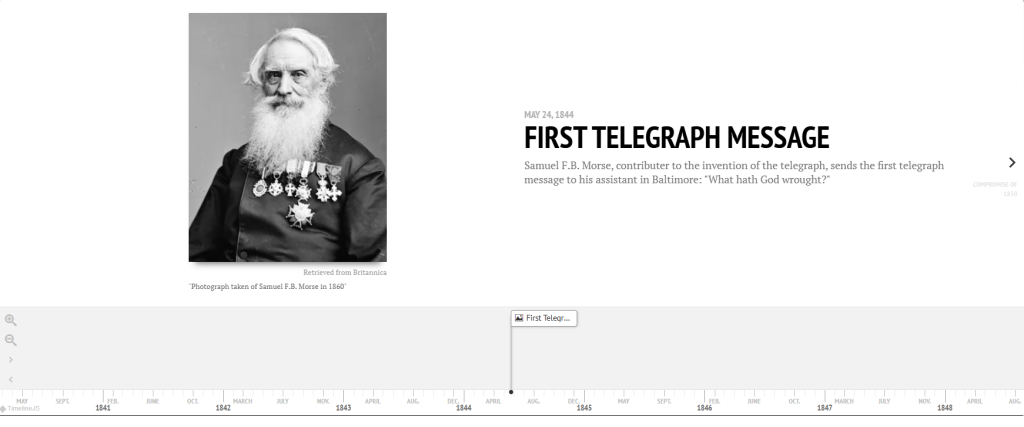
Visit the Episode Timeline on Knightlab.JS Timeline Creator – Click the Button Below
Timeline created using Knightlab’s timeline creator.
Sourcing
Annotated Bibliography – Primary and Secondary Sources
Annotated Bibliography
Secondary Sources
Bergmann, William H. “Delivering a Nation through the Mail: The Post Office in the Ohio Valley, 1789 – 1815.” Ohio Valley History (Cincinnati) 8, no. 3 (2008): 1–18. Describes the early United States postal system as a fundamental nation-building institution in the early West / Ohio Valley. Argues that the expansion of postal services encouraged economic development and early settlement, as well as fostered a sense of nationalism by connecting settlers to the federal government in the east.
Eyal, Yonatan. “With His Eyes Open: Stephen A. Douglas and the Kansas-Nebraska Disaster of 1854.” Journal of the Illinois State Historical Society (1998-) 91, no. 4 (1998): 175–217. http://www.jstor.org.proxy2.library.illinois.edu/stable/40193287. Information on Stephen Douglas, sectionalism, Illinois political scene, and Kansas-Nebraska act.
Johannsen, Robert W. “Stephen A. Douglas, ‘Harper’s Magazine,’ and Popular Sovereignty.” The Mississippi Valley Historical Review 45, no. 4 (1959): 606–31. https://doi.org/10.2307/1888713. Johannsen analyzes Stephen Douglas’ controversial essay defending the doctrine of popular sovereignty, published in Harper’s Magazine. Also describes Douglas’ position within the Democratic Party between his reelection to the Senate and the election of 1860. Mentions Douglas’ dismissal from the chairmanship of the U.S. Senate Committee on Territories as a result of his defense of popular sovereignty.
Morris, Roy Jr., The Long Pursuit: Abraham Lincoln’s Thirty-Year Struggle with Stephen Douglas for the Heart and Soul of America, Washington D.C.: Smithsonian, 2008. Information on Lincoln and Douglas’s relationship after the 1860 election, including Lincoln’s inauguration and Douglas’s death.
Oertel, Kristen T. “Bleeding Kansas: A Call to Arms.” In The Oxford Handbook of the American Civil War, edited by Lorien Foote and Earl J. Hess. Oxford University Press, 2021. https://doi.org/10.1093/oxfordhb/9780190903053.013.4. Information on the actions of settlers, both pro and anti slavery, in the Kansas Territory during the period to be known as Bleeding Kansas. Describes how the mobilization of men and women into paramilitary groups foreshadowed the Civil War.
Ross, Dorothy. “Lincoln and the Ethics of Emancipation: Universalism, Nationalism,
Exceptionalism.” The Journal of American History 96, no. 2 (2009): 379–99. Ross offers valuable insights into the nationalistic elements of anti-slavery and abolition arguments. Ross’s work is used in the podcast to make an argument for the nationalistic character of Lincoln’s arguments, therefore linking the debates to the character of the nation at the time.
Wang, Tianyi. “The Electric Telegraph, News Coverage, and Political Participation.” The Journal of Economic History 85, no. 1 (2025): 1–32. https://doi.org/10.1017/S0022050725000026. Describes how faster access to national political news, made possible by the invention of the telegraph, increased voter turnout across the country. The telegraph allowed for greater newspaper coverage of Congress and the presidency, which then led to greater democratic participation.
Zarefsky, David. “Lincoln, Douglas, and Slavery: In the Crucible of Public Debate.” (Chicago: University of Chicago Press), 1990, 62. Zarefsky’s work is the most useful for helping to understand the rhetorical character of the debates. Not only does Zarefsky offer information about each debate individually, but he also follows several key lines of argument made throughout all of the debates. Where this work was most useful was in its noting of the change in the character of the debates starting with the 5th in Galesburg.
Stephen A. Douglas: A Featured Biography,” United States Senate, Accessed April 19, 2026,
https://www.senate.gov/senators/FeaturedBios/Featured_Bio_Douglas_Stephen.htm. Basic biographical information on Stephen Douglas
Bleeding Kansas: A Stain on Kansas History, Accessed April 19, 2026,
https://www.nps.gov/articles/bleedingks.htm.Information on Bleeding Kansas and the Marais des Cygnes Massacre
Primary Sources
Abraham Lincoln, “First Inaugural Address of Abraham Lincoln,” 1861. Quoted briefly at the end of the podcast
Abraham Lincoln and Stephen A. Douglas. “The Lincoln-Douglas Debates: 1st Debate.”
Teaching American History. August 21, 1858. Accessed April 27, 2026. https://teachingamericanhistory.org/document/the-lincoln-douglas-debates-1st-debate/. This source is the text for Lincoln and Douglas’s first debate in Ottawa which is a central source to our project. We will use this source to explore Lincoln’s rhetoric throughout the debates. This source is also used as a dramatic staging device to kick off the podcast.
Abraham Lincoln and Stephen A. Douglas, “The Lincoln-Douglas Debates: 4th Debate, Part I,”
Teaching American History, September 18, 1858, accessed April 27, 2026, https://teachingamericanhistory.org/document/the-lincoln-douglas-debates-4th-debate-part-i/. In the context of this project, this source will be used the same as the other debates. It will also specifically be used to showcase Lincoln’s racist statements during this debate.
Abraham Lincoln and Stephen A. Douglas, “The Lincoln-Douglas Debates: 5th Debate,”
Teaching American History, October 7, 1858, accessed April 27, 2026, https://teachingamericanhistory.org/document/the-lincoln-douglas-debates-5th-debate/. This is an important debate for framing the national character of Lincoln and Douglas’s Rhetoric. Here, Lincoln begins to press the attack with respect to Douglas’s specific views on the morality of slavery.
Abraham Lincoln and Stephen A. Douglas, “The Lincoln-Douglas Debates: 6th Debate, Part I,”
Teaching American History, October 13, 1858, accessed April 27, 2026, https://teachingamericanhistory.org/document/the-lincoln-douglas-debates-6th-debate-part-i/. The sixth debate serves much of the same purpose as the 5th.
Abraham Lincoln and Stephen A. Douglas, “The Lincoln-Douglas Debates: 7th Debate, Part I,”
Teaching American History, October 15, 1858, accessed April 27, 2026, https://teachingamericanhistory.org/document/the-lincoln-douglas-debates-7th-debate-part-i/. The seventh debate will be used to conclude the points about Lincoln and Douglas’s rhetoric. Two quotes will be pulled that sum up well their thoughts on the issue of slavery and what it means to them and for the nation.
Abraham Lincoln. “Letter to Joseph O. Cunningham.” August 22, 1858. Lincoln writes to Joseph Cunningham, hoping to meet with him for unknown reasons in the middle of a busy campaign. Lincoln notes the size of the crowd in his debate with Douglas at Ottawa and notes that the exchange became heated.
Chicago Times (Chicago, IL). “The Campaign — Douglas Among the People.” August 22, 1858.
Newspaper article published following the Lincoln-Douglas debate in Ottawa, IL. States that Douglas was the superior orator and embarrassed Lincoln to the point of paralysis.
Fremont Journal (Fremont, OH). “The Contest in Illinois.” September 3, 1858. Describes the debate between Lincoln and Douglas in Ottawa, IL as a great spectacle that bears more resemblance to a presidential election than a congressional one. Differing from accounts of the debate published in Democratic-affiliated newspapers, the column portrays Douglas as disappointing and intimidated by the “suavity” of Linoln. Contrats Douglas’ supports to Lincolns as being comprised of drunkards and other “rabble.” Reports that Lincoln’s performance was met with such approval that his supporters paraded him through the city to the mayor’s residence.
Morse, Samuel F. B. “Letter to Alfred Vail.” July 26, 1844. Letter from Samuel Morse, contributor to the invention of the telegraph, to his assistant Alfred Vail; Morse warns Vail against the misuse of the invention and encourages Vail to be careful to not spread information with a partisan character.
Press and Tribune (Chicago, IL). “Douglas Puffers and Valets.” September 20, 1858.Describes the two reporters who accompanied Douglas during his canvass of Illinois as liars and accuses Douglas of encouraging them to alter transcripts of his debates with Lincoln to make his own position appear better. Says the transcript of the debate at Jonesboro, published in the Chicago Times, was “mutilated.”
Semi-Weekly Standard (Raleigh, NC). “The Contest in Illinois.” September 25, 1858.Column that expresses outrage over Douglas support of popular sovereignty, as well as his ideological split with President James Buchanan; specifically on the case of Kansas’ admission to the Union. Writes that an abolitionist national government would result in Southern resistance, and Douglas’ return to the Senate and his rumored run for the presidency in 1860 would also precipitate “black Republican” control.
The Daily American (Manchester, NH). “Douglas and the Illinois Election.” July 15, 1858. Describes the coming election between Lincoln and Douglas as an indicator for the platforms to be adopted by the Republican and Democratic parties in the presidential election of 1860, but also firmly states that Douglas cannot expect to be the Democratic nominee for president in 1860 due to his support of popular sovereignty. Endorses Lincoln, but expresses a general hope for his successor in the Senate to be a “more honest” man.
Wilmington Journal (Wilmington, NC). “Douglas’ Relations to the Democratic Party.” August 27, 1858.Published copy of a letter by Democratic Missouri Senator James S. Green, in which he expresses his doubts on the political future of Douglas due to his actions regarding the admission of Kansas. He writes that Douglas could become affiliated with the Republican Party by 1860, and refuses to appear with him—at least for a majority of events—on the canvass of Illinois due to his being uncertain of Douglas’ “fidelity.”
Wilmington Journal (Wilmington, NC). “The Heresies of Douglas.” October 29, 1858. Column decrying Douglas’ support of popular sovereignty as a betrayal of Southern interests — the outrage of the authors of the column stems from their expressed belief that local government is obligated to protect personal property, in this case slaves, and their voting against slavery as permitted under popular sovereignty is heresy. The newspaper reluctantly endorses Douglas for reelection.
Credit this Episode
Bibliographic Style: The Fine Print. “Episode 011: Decade of Debate: the Lincoln-Douglas Debates in Context.” The Fine Print: Framing the American Revolution and Republic at 250, University of Illinois Student History Podcast Project. Accessed Month, Date, Year. https://publish.illinois.edu/americanhistorypod/.
Note Style: The Fine Print, “Episode 011: Decade of Debate: the Lincoln-Douglas Debates in Context,” podcast episode, accessed Month Day, Year, https://publish.illinois.edu/americanhistorypod/.